2026-09-29T13:38:13.518Z ·
How to Read Your Water Meter to Check for a Leak
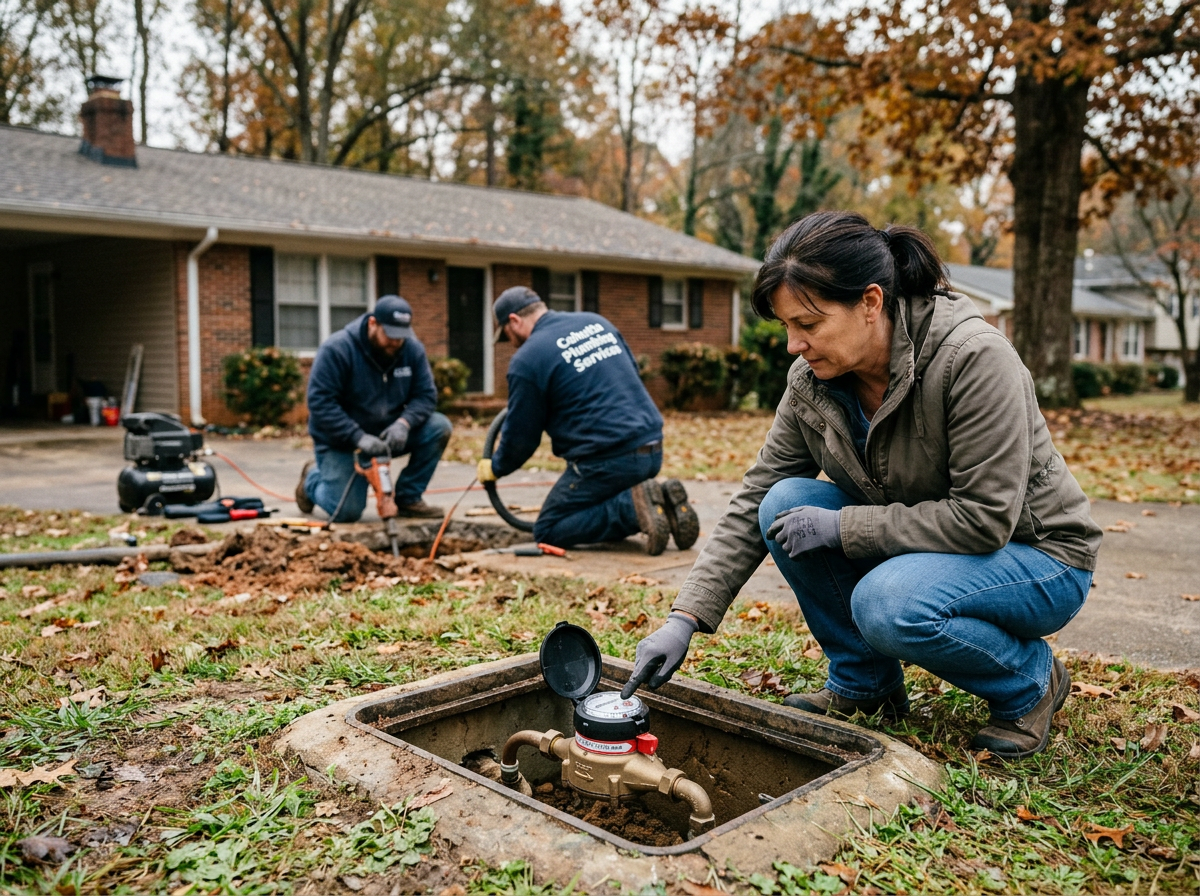
Your water meter is the simplest leak detector you have. In about ten minutes, with nothing but a flashlight, you can tell whether water is leaving your plumbing when nothing is supposed to be running. Here's how to do it, and how to read what you see.
Step 1: Find the meter
On the public water system, the meter is usually in a box set into the ground near the road or the edge of the property, with a metal or plastic lid. Lift the lid carefully. It may hold water, dirt or the occasional insect, so a screwdriver or meter key helps.
If you're on a private well, as many homes in rural north Whitfield County are, there is no utility meter. Skip to the well section below.
Step 2: Know what you are looking at
Most meters have:
- A number display like a car odometer, showing total water used.
- A sweep hand that goes round as water is used.
- A leak indicator, usually a small triangle, star or wheel that spins with even a tiny flow.
The leak indicator is the one that matters for this test.
Step 3: Turn everything off
- All taps, inside and outside
- Dishwasher and washing machine
- Ice maker and fridge water line
- Irrigation or sprinkler system
- Any water softener or filter that might be regenerating
Make sure nobody in the house uses water during the test.
Step 4: Watch for ten minutes
Look at the leak indicator. If it is completely still, you have no measurable leak right now. If it moves, even slowly, water is going somewhere.
For a second check, write down the full reading, wait an hour or two without using any water, then read it again. Any change means a leak.
Step 5: Narrow it down
A moving meter doesn't automatically mean a slab leak. Rule out the common causes first.
- Toilets. Put a few drops of food colouring in the tank. If colour appears in the bowl within 15 minutes without flushing, the flapper is leaking.
- Dripping taps and outdoor spigots.
- The water heater relief valve, which can drip into a drain pipe you never see.
- The service line between the meter and the house. A leak there often shows as soggy ground in the yard.
Some homes have a shutoff valve where the line enters the house. If closing it stops the meter, the leak is inside the house. If the meter keeps moving, the leak is on the line outside.
If you're on a well
Without a meter, listen for the well pump. If it switches on when nobody is using water, or cycles on and off at night, water is leaking from the system somewhere. The same narrowing-down steps apply.
When it points to a slab leak
If the meter moves, the toilets and taps are fine, and the leak is inside the house, a line under the slab is a strong suspect, especially with a warm spot on the floor or damp flooring. Check our list of the signs of a slab leak.
The next step is professional slab leak detection, which pinpoints the leak with acoustic and thermal equipment before any concrete is opened. If you have water surfacing, go straight to emergency slab leak repair.
Keep a note of your readings: they are useful for the plumber, and for your insurer if you make a claim (see does insurance cover a slab leak?).
Call for a quote if your meter says water is going somewhere it shouldn't.